AI
RAG Gave AI the Handbook. It Read the Convenient Half.
Noah asks about remote work. AI finds the yes, loses the approval condition, and arrives at Monday with confidence. Follow the fictional question through a RAG system.

On this pageJump to section
Introduction
In this fictional example, Noah asks the company assistant whether he can work remotely on Monday. It finds “Remote work is available” in the handbook and gives him a confident yes. Noah closes his laptop. Somewhere in the same handbook, “Manager approval is required” is clearing its throat.
The assistant had access to the document. It still delivered the answer Noah wanted before collecting the condition Noah needed. A remarkably efficient way to create a Monday conversation with the manager.
Retrieval-augmented generation, or RAG, finds relevant source material and supplies it to a model before it writes an answer. The useful question is whether the system retrieves enough of the applicable rule and preserves its meaning. An open book helps; it does not read itself.
Give the assistant the rule, not just the good news
A document-grounded system prepares sources for search, retrieves passages for the question, and generates an answer using those passages. Connecting output to source material can make it more supportable and auditable; it does not remove the need to evaluate the result.Google Cloud: Grounding overview
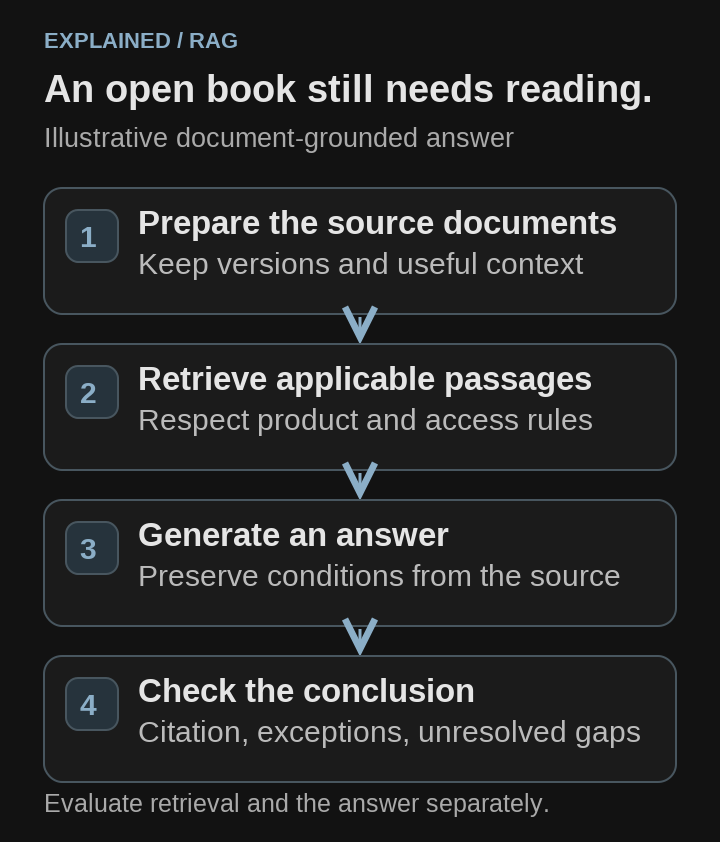
Evaluate whether retrieval found the applicable policy and approval condition, then whether the answer preserved them. A good-looking response can fail either check. Preparing sources, choosing passages, and applying their meaning are separate responsibilities.
The approval condition was sitting on the next page
Long documents are often split into retrievable passages. Useful boundaries and context help related information remain understandable. Document structure, headings, and layout can affect chunking; there is no single size that guarantees correct retrieval for every collection.Google Cloud: Parsing and chunking documents for RAG
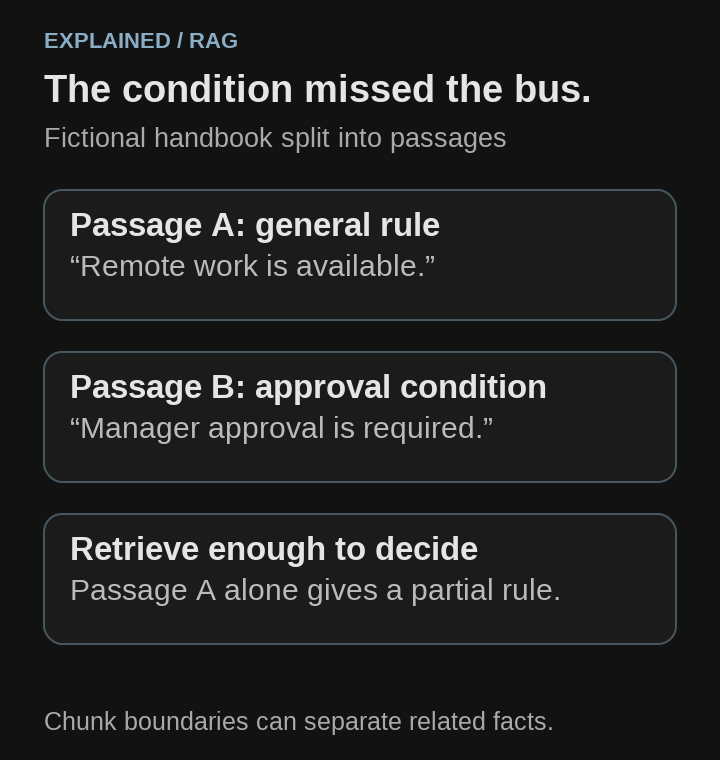
If retrieval supplies only “Remote work is available,” the model has received a partial rule. Retrieve enough context to include “Manager approval is required” and keep the source reference. Extra fluency cannot reconstruct the missing condition reliably.
For Noah, retrieving only the permission is like forwarding the first half of a message because the rest looked inconvenient. The approval condition still applies. It simply was not in the material handed to the model, which cannot be relied on to reconstruct it.
A very similar handbook may belong to someone else
Vector search retrieves items by distances between their representations. pgvector adds vector similarity search to PostgreSQL. A close match can help find related wording, but it does not establish which policy applies to this employee.pgvector: Vector search for PostgreSQL
A contractor guide may look remarkably like Noah’s staff handbook. That does not make its rules apply to him. Filter for the right organization, access rights, and version. The model has found a convincing answer; now check whether it wandered into a different company to get one.
The assistant is quoting last month’s manager
Updating the source is not enough if ingestion leaves obsolete passages active. Track source versions and ingestion status, retire superseded material deliberately, and make failed updates visible.
Suppose an older version allowed self-approval while today’s requires manager approval. Noah needs today’s rule, even if the older one is easier to like. Generating the answer this morning does not make its source current. Yesterday’s handbook can still turn up to work wearing a brand-new paragraph.
Check the passage and the conclusion separately
For the Monday question, inspect what was retrieved. Did it contain the remote-work permission and approval condition? Then inspect the answer. Did it retain that condition, or turn a conditional policy into unconditional permission?
- Use representative questions with expected source passages.
- Test version, access, and exception handling.
- Check whether cited evidence supports the full answer.
- Include questions the approved collection cannot resolve.
If the approved sources do not establish whether Noah’s manager approved Monday, the assistant should say that and ask for the missing confirmation. A useful answer keeps the permission and its condition together. Noah can then plan his week with an actual decision, and the manager can retire from correcting the company chatbot before coffee.
Key takeaways
- Evaluate retrieval and answer generation separately.
- Keep conditions, document context, and current versions accessible.
- Similarity is not proof of applicability or permission.
- Allow an honest gap when approved sources cannot resolve the question.