AI
GPT-6.1 Sol vs Astra vs Claude 5.5: Four Models, One Broken Button
Sol, Astra, Opus, and Sonnet have arrived to fix a form that eats your text. Compare verified API rates and a worked bill, then give the patch its own performance review.
On this pageJump to section
Introduction
Imagine filling out a long enquiry form, clicking Submit, and watching an error erase everything you typed. The form has declined your request and shredded the paperwork. Very thorough.
You ask AI to fix it. Sol and Astra arrive with celestial name badges. Opus and Sonnet bring the arts department. Four candidates, one ordinary bug, and a customer who would quite like their paragraph back.
Which candidate earns the job? Below are official specifications and an equal-token cost example checked on October 12, 2026. The broken form is hypothetical; these are not personal benchmark results. Nobody gets hired on the strength of a dramatic entrance.
Meet the candidates. Leave the name badges outside.
OpenAI positions Sol for complex work at a lower cost with performance approaching Astra, and Astra for its most demanding work. Anthropic positions Opus 5.5 for sustained coding and knowledge work, and Sonnet 5.5 for a speed-and-intelligence balance. These are vendor descriptions, not results from a shared test.OpenAI: GPT-6.1 Sol specifications and API pricingOpenAI: GPT-6 Astra specifications and API pricingAnthropic: Claude Opus 5.5 specificationsAnthropic: Claude Sonnet 5.5 specifications and migration notes
“Claude 5.5” needs a surname: Opus and Sonnet have different rates. “Near Astra” is a vendor positioning claim, not a promise of identical patches on your repository. Before the introductions turn into a talent show, hand everyone the same broken form.
The API bill has entered the meeting
First, meet the accountant. These are Standard API prices in USD per million tokens, the units used to measure model input and output. The OpenAI figures apply to requests with at most 272,000 input tokens; Claude cache writes below use the five-minute rate.OpenAI: GPT-6.1 Sol specifications and API pricingOpenAI: GPT-6 Astra specifications and API pricingAnthropic: API pricing, caching, and long-context ratesOpenAI: API pricing and processing modes
| Model | Input | Output | Cached input | Cache write |
|---|---|---|---|---|
| GPT-6.1 Sol | $2 | $10 | $0.10 | $2.50 |
| GPT-6 Astra | $10 | $50 | $1 | $12.50 |
| Claude Opus 5.5 | $4 | $20 | $0.20 | $5 (5m) |
| Claude Sonnet 5.5 | $2 | $10 | $0.10 | $2.50 (5m) |
- Above 272,000 input tokens, Sol and Astra charge 2× input/cache rates and 1.5× output rates across the full request.
- Claude lists standard token rates across the full 1M context window. Its one-hour cache writes cost $8 per million tokens for Opus 5.5 and $4 for Sonnet 5.5.
- Cache eligibility, duration, processing mode, tools, and regional modifiers can change the bill. The write columns do not establish identical caching behavior.
API usage and subscriptions have different billing rules. Dividing a ChatGPT, Codex, or Claude subscription price by this table will not tell you how many messages you get. The calculator will happily produce a number. It has no idea which billing department you meant.ChatGPT Learn: Model access in Work and Codex
Give the calculator a turn
Give each model 10,000 uncached input tokens and 2,000 total billable output tokens, including any billed reasoning. The estimate is 0.01 × input rate + 0.002 × output rate. No cache writes, tools, retries, or other modifiers are included.
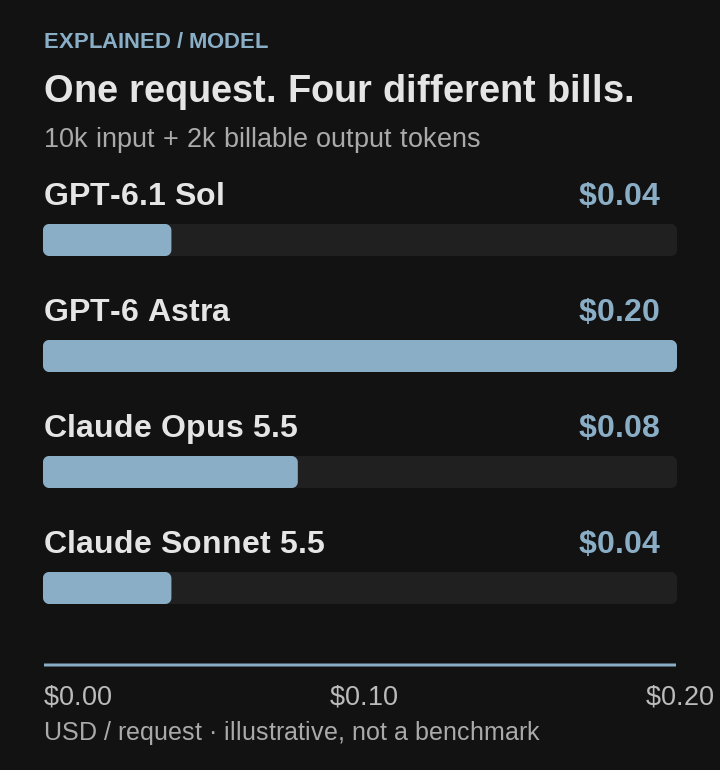
The calculation gives Sol $0.04, Astra $0.20, Opus $0.08, and Sonnet $0.04. That makes Astra five times and Opus twice the cost of Sol or Sonnet for these chosen counts. It says nothing about which model fixes the form.
| Model | One request | 1,000 identical requests |
|---|---|---|
| GPT-6.1 Sol | $0.04 | $40 |
| GPT-6 Astra | $0.20 | $200 |
| Claude Opus 5.5 | $0.08 | $80 |
| Claude Sonnet 5.5 | $0.04 | $40 |
Real runs do not politely consume identical token counts. Tokenizers, reasoning, retries, and review effort can differ. The cheaper first attempt might need three repairs; the expensive one might still proudly clear the form. Count all attempts and the time spent checking them. The invoice measures usage, not how impressed the Submit button should be.
A large bookshelf still needs a careful reader
Sol and Astra list 1,050,000-token context windows; Opus and Sonnet list 1M. All four accept text/images and produce text, with standard output limits of 128K tokens. Claude separately documents a 300K Message Batches output beta.OpenAI: GPT-6.1 Sol specifications and API pricingOpenAI: GPT-6 Astra specifications and API pricingAnthropic: Claude Opus 5.5 specificationsAnthropic: Claude Sonnet 5.5 specifications and migration notes
| Model | Context | Max output | Reasoning / thinking |
|---|---|---|---|
| GPT-6.1 Sol | 1,050,000 tokens | 128,000 tokens | low to max; default medium |
| GPT-6 Astra | 1,050,000 tokens | 128,000 tokens | low to max |
| Claude Opus 5.5 | 1M tokens | 128K tokens | Adaptive, always on; default medium |
| Claude Sonnet 5.5 | 1M tokens | 128K tokens | Adaptive; default high |
A large context window means the model can receive more material. It does not prove it noticed the one validation branch that deletes the text. Giving our candidates every folder is a generous onboarding package; giving them the failure, expected behavior, and relevant constraints is a useful brief.
The audition requires an actual working button
Write the audition rules before reading the candidates’ explanations: a failed submission keeps the entered values, the error is visible and accessible, retry works, and success resets only what it should. Give each candidate equivalent starting code and permissions. “I improved the experience” is a lovely sentence. Now make the server reject the form and inspect what happens.
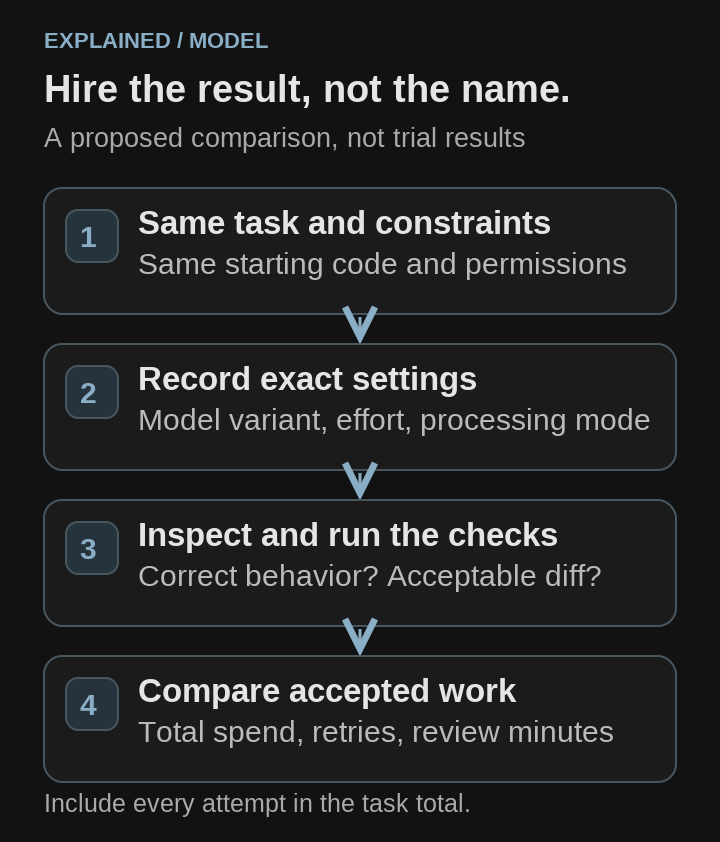
Record the exact model, reasoning setting, processing mode, and surrounding tools. Inspect the diff, run the acceptance checks, and log billed usage from every attempt alongside review minutes. Compare completed work, not how convincingly a model describes its patch.
Reasoning effort is another control to try, not a personality upgrade. OpenAI’s selection guidance recommends testing model-and-effort combinations on your work. Anthropic’s speed labels describe its own lineup; they do not establish a shared stopwatch ranking.OpenAI: Choosing models and reasoning effortAnthropic: Claude Opus 5.5 specificationsAnthropic: Claude Sonnet 5.5 specifications and migration notes
Choose the patch that lets you go home
Sol and Sonnet share the lowest base input/output rates in this group. Opus costs more at those rates; Astra costs more again. Use that to shortlist candidates, then test the tasks that actually matter to you.
Switching vendors also means checking request formats, tool calls, and thinking controls. Similar names do not make the APIs interchangeable. Read the migration guidance before replacing an ID and hoping for the best.OpenAI: GPT-6 API and migration guidanceAnthropic: Claude Sonnet 5.5 specifications and migration notes
Pick a default from accepted results, total spend, and review effort, with an alternative when your trials justify one. Then return to the customer’s form and make the failed submission happen again. The winning candidate leaves their paragraph intact. The customer does not need to know whether a star or a sonnet rescued it.
Key takeaways
- Identify the exact variant: Opus and Sonnet 5.5 have different rates.
- At the Standard rates shown, equal-token arithmetic gives Sol/Sonnet $0.04, Opus $0.08, and Astra $0.20 per illustrative request.
- Check cache, context thresholds, processing mode, and tool charges separately from subscriptions.
- Choose using accepted work, total usage, and review effort on equivalent tasks.
Sources and further reading
- OpenAI: GPT-6.1 Sol specifications and API pricing
- OpenAI: GPT-6 Astra specifications and API pricing
- Anthropic: Claude Opus 5.5 specifications
- Anthropic: Claude Sonnet 5.5 specifications and migration notes
- Anthropic: API pricing, caching, and long-context rates
- OpenAI: Choosing models and reasoning effort
- OpenAI: GPT-6 API and migration guidance
- ChatGPT Learn: Model access in Work and Codex
- OpenAI: API pricing and processing modes