Tech Explained
One Listing, Two Statuses. The Apps Have Started a Group-Chat Argument.
The provider says taken. The website says available. The search index would like to read yesterday’s messages first. Follow one fictional listing through the disagreement.

On this pageJump to section
Introduction
In this fictional example, a property provider marks a listing as taken. The website still says available. Search agrees with the website. Your browser has been away from the conversation and is confidently repeating yesterday.
You refresh everything. The apps continue their group-chat argument. Nobody appears to have read the important message.
Each screen may read a different copy of the same record, with its own path for receiving updates. Follow the listing through those paths to find who is behind and what a user can safely rely on.
The listing has copies. They do not share a brain.
A provider’s record may be copied into a website database, a search index, and a browser cache. Those copies can support importing, rendering, searching, and faster reads. A separate search index needs its own update process.Algolia: Updating records in a separate search index
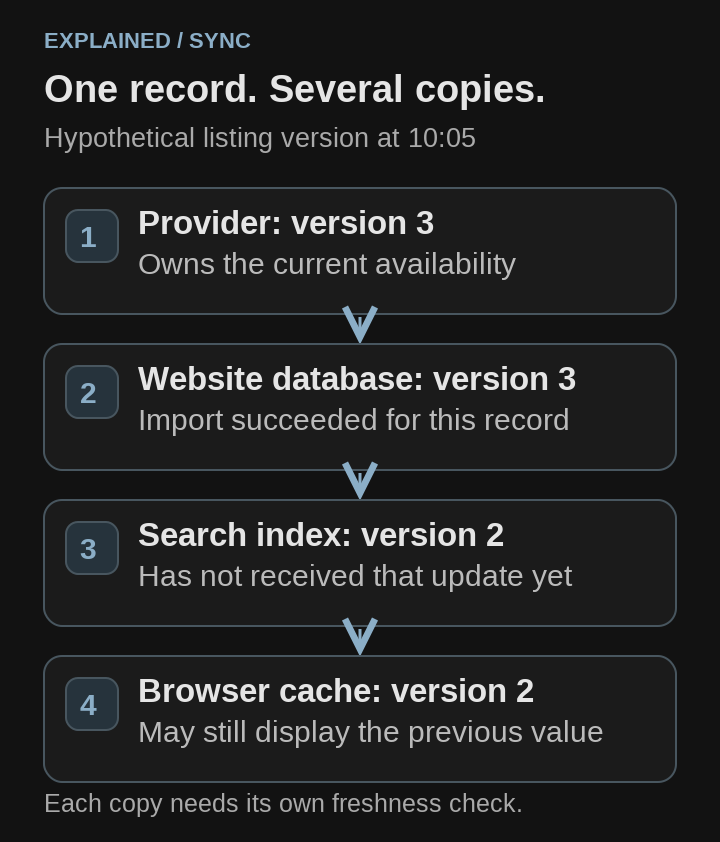
Here the provider and website database hold version 3 while the search index and browser still hold version 2. This does not describe a measured system or a universal delay. Inspect each update path to discover where a real application fell behind.
The page loading successfully proves that a page arrived. It does not prove our listing’s status is current. All the pixels can show up on time while the data brings yesterday’s lunch.
“Saved” did not notify the entire group chat
A successful save can establish that the primary system stored the change while downstream copies are still updating. Whether that delay is acceptable depends on the feature. A directory description and a final availability decision have different needs.
For our property, check current availability with the system responsible for the final action. A cached badge can help someone browse; it should not make the final reservation decision. “Available” from a copy that has not caught up is an opinion from the least informed member of the group chat.
Yesterday’s update has finally discovered the Send button
Suppose version 2 says available and the later version 3 says taken. The network delivers version 3 first, then the delayed version 2. Applying the last arrival blindly puts the office back on the market. Version 2 has arrived late and immediately started contradicting everyone.
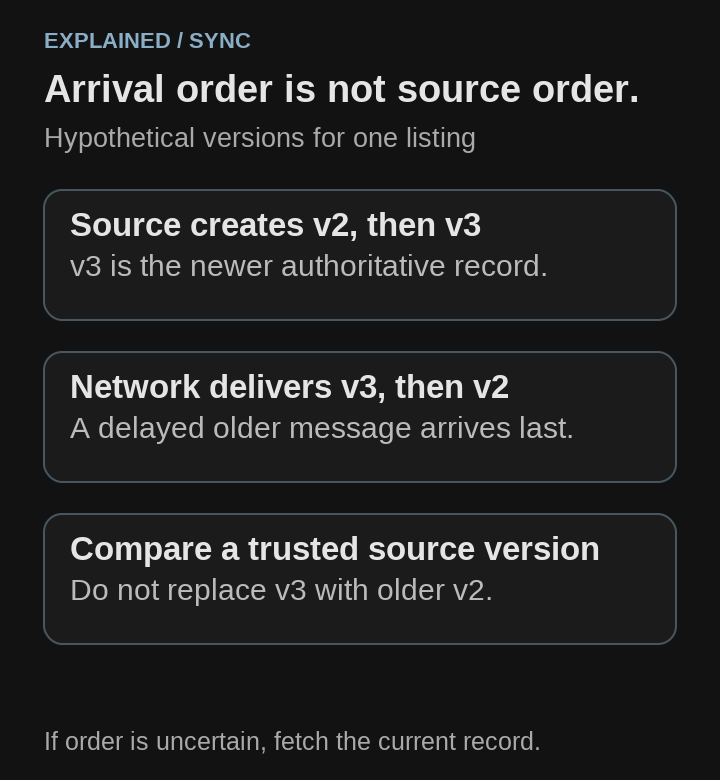
Recognize the authoritative source order before applying an update. A trusted monotonic version can help reject older messages. If the source provides no reliable ordering signal, retrieve the current record or use another explicit reconciliation strategy.
Retries need a stable identifier so the same listing can be recognized again. PostgreSQL’s ON CONFLICT operations can insert or update against a defined unique constraint. They do not decide which source version is newest. Recognizing the person in the group chat and believing their latest message are separate jobs.PostgreSQL: INSERT and conflict handling
A dropped call does not demolish the missing properties
Imagine an import with five pages that fails after the third. Properties on the last two pages have not been checked; they have not been proven deleted. Removing them anyway would let a failed connection become your most destructive property manager.
Separate incomplete runs from completed snapshots. Respect field ownership too: a provider’s availability update should not casually overwrite an editor’s neighborhood description. Two systems can share a record without owning every field.
Tell the user which copy they are seeing
Show the last successful refresh and whether newer work failed. For operators, expose the affected records and a way to retry or reconcile them. For users, make clear where the final decision is checked.
- Track freshness for each copy, not just page-load success.
- Handle duplicate and out-of-order updates explicitly.
- Do not infer deletion from a partial snapshot.
- Give failed updates an observable recovery path.
After fixing the failed update path, check the copies again and verify the final action against its proper authority. Repeatedly refreshing our listing cannot make an import job finish. The group chat needs the missing update, not another notification asking why everyone disagrees.
Key takeaways
- Different screens can read different versions of one record.
- Define freshness needs and the authority for the final action.
- Stable identity and source ordering solve different problems.
- Keep incomplete syncs visible and recoverable.